 By chloe
 You’ve probably felt it. That moment when you’re about to donate $15 to a cause you care about, then pause. Will this even matter? Some billionaire probably just wrote a check for millions. Your small gift feels like tossing a pebble into the ocean.
Here’s what charities won’t always tell you upfront: they need your $15 more than you think. Not just the money itself, but what it represents. Your small donation does something that massive gifts from wealthy donors simply cannot do.
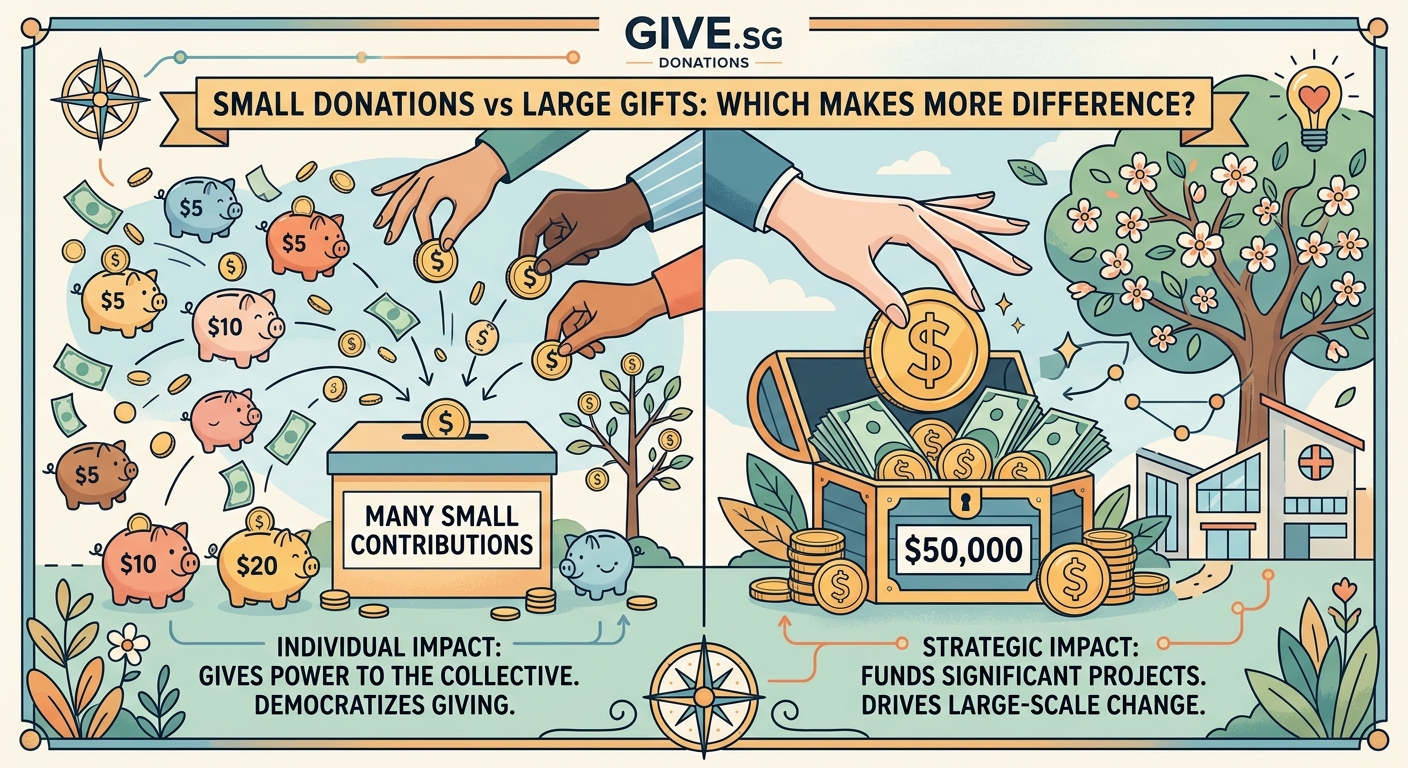
Small donations form the backbone of sustainable [nonprofit funding](https://en.wikipedia.org/wiki/Charitable_organization). They signal broad community support, reduce dependency on wealthy donors, cover operational costs that major gifts ignore, and create loyal long-term supporters. Your $10 or $20 matters because charities need predictable, unrestricted funds from many people, not just occasional windfalls from a few. Collective giving from everyday donors often exceeds total contributions from major philanthropists.
Why Charities Actually Prefer Your Small Donation
Large donations grab headlines. A tech founder gives $50 million to build a new hospital wing. The naming rights get announced. Everyone celebrates.
But here’s the reality behind those press releases.
Big gifts almost always come with strings attached. The donor wants the money used for specific projects. They want their name on a building. They demand progress reports and veto power over decisions. These restrictions create headaches for nonprofit staff who need flexibility to respond to changing needs.
Your $25 donation? It comes with zero conditions. The charity can use it however they need. Maybe that means paying the electric bill. Or buying printer paper. Or covering staff salaries for the people who actually run the programs.
These unsexy expenses keep organizations alive. Major donors rarely want their millions going toward rent and utilities. They want transformative impact. But you can’t transform anything if you can’t keep the lights on.
The Numbers Tell a Surprising Story
Let’s look at actual data from nonprofit funding.
According to Giving USA, individual donations from everyday people make up about 67% of all charitable giving in the United States. Foundations contribute roughly 19%. Corporations give around 5%. The remaining percentage comes from bequests.
That means regular people like you provide two-thirds of all charitable funding. Not billionaires. Not corporations. Everyday donors writing checks for $10, $50, or $100.
Even more striking: small donors give more consistently. A study by the Fundraising Effectiveness Project found that donors who give less than $250 have higher retention rates than major donors. They keep giving year after year. Wealthy philanthropists are fickle. They shift priorities. They get bored. They move on to the next trendy cause.
Your modest monthly donation creates predictable revenue. Charities can budget around it. They can plan programs knowing that money will arrive.
What Your Small Donation Actually Funds
Here’s a breakdown of how small donations support charity operations:
| Donation Amount | What It Can Cover | Why It Matters |
|---|---|---|
| $10 | School supplies for one student | Unrestricted funds fill gaps major grants miss |
| $25 | One week of meals for a shelter resident | Immediate needs that can’t wait for big fundraising campaigns |
| $50 | Veterinary care for a rescue animal | Operational costs that keep programs running daily |
| $100 | Job training materials for one person | Flexible funding staff can allocate where most needed |
| $250 | One month of after-school programming | Sustainable support that doesn’t disappear when a major donor leaves |
These amounts might seem small individually. But multiply them by thousands of donors and you’re funding entire organizations.
The Ripple Effect You Create
Your donation does more than provide money. It sends signals.
When a charity applies for grants from foundations or government agencies, reviewers look at donor diversity. They want to see broad community support. An organization with 5,000 small donors looks healthier than one dependent on five wealthy benefactors.
Your $20 gift proves that regular people believe in this cause. That validation helps charities secure larger institutional funding. Grant makers feel more confident investing in organizations with strong grassroots support.
Your donation also creates social proof. When your friends see you supporting a cause, some will follow. Charitable giving spreads through social networks. One person’s $15 donation inspires three friends to give $15 each. Those friends inspire their networks. The effect compounds.
How Small Donations Build Lasting Relationships
Charities view small donors as future major donors. Not because they expect you to suddenly become wealthy. But because consistent small giving demonstrates commitment.
Consider this typical donor journey:
- Someone makes their first $10 donation after seeing a social media post
- They receive a thank you email and feel good about contributing
- Six months later, they donate $25 when the charity sends an urgent appeal
- The following year, they sign up for a $15 monthly recurring donation
- After five years of monthly giving, they’ve contributed $900 total
- They feel invested in the organization’s success and volunteer their time
- Eventually, they include the charity in their estate planning
That progression happens constantly. Small donors become deeply engaged supporters. They volunteer. They advocate. They recruit other donors. They leave bequests in their wills.
Major donors rarely follow this path. They write one large check, attend a gala, then disappear. They don’t develop the emotional connection that comes from years of modest, consistent support.
“Small donors are the lifeblood of our organization. They give us stability, flexibility, and proof that our community believes in our mission. A single $1 million gift might fund a project, but 10,000 people giving $100 each funds our future.” — Executive Director, national education nonprofit
The Power of Collective Giving
Think about crowdfunding campaigns. They prove how small amounts add up fast.
A teacher needs $500 for classroom supplies. Within a week, 50 people donate $10 each. Goal reached. The project happens. Each donor spent less than a lunch out, but together they made something real occur.
This same principle applies to all charitable giving. Small donations aggregate into substantial impact.
Consider these real examples:
- A local food bank receives an average donation of $35 from 12,000 donors annually, generating $420,000 in unrestricted operating funds
- An animal rescue gets $15 monthly donations from 800 supporters, creating $144,000 in predictable annual revenue
- A youth mentoring program has 2,000 donors who give $50 each during their annual campaign, raising $100,000 in three weeks
None of these organizations could function on major gifts alone. They need the collective power of many small donors.
Where Small Donations Matter Most
Certain types of charities depend heavily on small donor support.
Local organizations serving specific communities thrive on modest donations from people who live nearby. A neighborhood food pantry doesn’t attract billionaire philanthropists. But residents who walk past it daily will donate $20 here and there.
Grassroots advocacy groups fighting for policy changes rely on small donors who care deeply about the issue. Environmental groups, civil rights organizations, and community organizing efforts build power through thousands of small contributions from passionate supporters.
Newer charities without established reputations struggle to attract major donors. They prove their worth by building a base of small donors first. Once they demonstrate community support and program effectiveness, larger funders take notice.
Faith-based organizations have always understood this model. Churches, synagogues, mosques, and temples operate primarily on small weekly donations from members. This distributed funding model creates resilience and community ownership.
What Happens When Small Donors Stop Giving
The pandemic showed what happens when small donations dry up.
Many charities lost 30% to 50% of their small donor base in 2020. People faced financial uncertainty. They cut discretionary spending, including charitable giving. Organizations that had relied on broad donor bases suddenly faced budget crises.
Meanwhile, wealthy donors actually increased their giving during the pandemic. But their large gifts went to specific COVID relief efforts or capital campaigns. Charities still couldn’t pay rent or staff salaries.
The organizations that survived had diversified funding. They had enough small donors to weather the storm. The ones that collapsed had become too dependent on a few major gifts.
This pattern repeats during every economic downturn. Small donors provide stability. Major donors provide volatility.
Common Mistakes Small Donors Make
Even though small donations matter enormously, donors sometimes undermine their own impact. Here are patterns to avoid:
- Spreading donations too thin: Giving $5 to 20 different charities creates administrative costs that eat up your contribution. Better to give $100 to one organization you trust.
- Only giving during disasters: Charities need consistent support year-round, not just when crises make headlines. Your $25 in July matters as much as your $25 after a hurricane.
- Assuming someone else will donate: The bystander effect applies to charitable giving. Don’t wait for others to step up. Your contribution matters regardless of what others do.
- Ignoring local organizations: National charities get attention, but local groups often need small donations more desperately and use them more efficiently.
- Never increasing donation amounts: If you’ve been giving $10 annually for five years, consider bumping it to $15. Even small increases compound over time.
How to Make Your Small Donation Count More
You can amplify the impact of modest contributions with smart strategies.
Set up recurring monthly donations. A $10 monthly gift totals $120 annually. More importantly, it provides predictable revenue charities can budget around. Monthly donors cost less to retain than one-time donors, so more of your money goes to programs.
Give unrestricted donations. Resist the urge to specify exactly how your $25 should be used. Trust the organization to allocate funds where needed most. Unrestricted money has far more value than restricted donations.
Donate during matching campaigns. Many charities run campaigns where a major donor matches all small donations dollar-for-dollar. Your $50 becomes $100. These matches often have caps, so donate early in the campaign.
Cover processing fees. When donating online, check the box to cover credit card processing fees. This ensures your full donation amount reaches the charity instead of losing 3% to transaction costs.
Give on Giving Tuesday or year-end. Many charities receive matching funds during these periods. Your donation might be doubled or tripled without any extra cost to you.
The Psychological Benefits You Receive
Small donations benefit you as much as the charities you support.
Research shows that giving money away activates pleasure centers in your brain. You get a literal dopamine hit from donating. This effect occurs regardless of donation size. Your brain rewards you the same for giving $10 or $1,000.
Regular charitable giving also correlates with better mental health outcomes. Donors report higher life satisfaction, lower depression rates, and stronger sense of purpose. The act of contributing to something larger than yourself creates meaning.
Small donations feel manageable. You don’t experience the anxiety that comes with major financial decisions. You can give without worrying about your own financial security. This removes psychological barriers that prevent people from donating at all.
You also build an identity as a generous person. Each small donation reinforces this self-concept. Over time, charitable giving becomes part of who you are, not just something you occasionally do.
Why Your $10 Matters as Much as Their $10 Million
Let’s address the core question directly: do small donations make a difference?
Absolutely yes. Here’s why.
Charities measure impact in multiple ways. Money is just one metric. They also value:
- Number of donors (shows community support)
- Donor retention rate (indicates satisfaction and trust)
- Unrestricted vs. restricted funds (determines operational flexibility)
- Donor engagement beyond giving (volunteering, advocacy, recruitment)
- Sustainable revenue sources (predictable vs. one-time gifts)
Your small donation scores high on all these measures. A billionaire’s massive gift might score high on total dollars but low on everything else.
Furthermore, your donation represents a larger personal sacrifice. Someone donating $10 from a $30,000 annual income gives more meaningfully than someone donating $10,000 from a $10 million income. Charities recognize this. They value your commitment, not just your capacity.
The nonprofit sector would collapse without small donors. Full stop. Major gifts fund special projects and capital campaigns. Small donations keep organizations alive day to day, year to year, decade to decade.
Your Modest Gift Creates Real Change
Stop second-guessing your $15 donation. It matters. It always has. It always will.
The charities you support need your contribution. Not someday when you’re wealthier. Right now. Your small gift provides the flexible, unrestricted funding that keeps programs running. It signals community support that attracts larger grants. It creates sustainable revenue that survives economic downturns.
More importantly, your donation makes you part of a collective effort. You join thousands of other everyday people who together fund the causes that matter. That’s not a small thing. That’s how real change happens.
So next time you hesitate before clicking that donate button, remember this: your modest gift does exactly what you hope it does. It makes a genuine difference in the world. And that’s worth every penny.