 By chloe
Your nonprofit just received a donation. But it’s not a check. It’s 500 boxes of cereal, 20 hours of legal advice, or free use of a warehouse for six months. Now what?
[In-kind donations](https://en.wikipedia.org/wiki/In-kind_donation) are non-cash contributions of goods, services, or expertise that help nonprofits reduce costs and expand capacity. Understanding how to request, evaluate, record, and acknowledge these gifts is essential for diversifying your funding sources while staying compliant with accounting standards and [IRS requirements](https://www.irs.gov/charities-non-profits/charitable-organizations). This guide covers everything from valuation methods to gift acceptance policies.
What are in-kind donations and why do they matter
In-kind donations are any contribution that isn’t cash. Instead of writing a check, donors give your organization something tangible or useful. This might be physical items like computers, food, or furniture. It could be professional services like graphic design, accounting, or legal counsel. Sometimes it’s access to space, like a donated venue for your annual gala.
These gifts matter because they fill gaps in your budget without draining your bank account. When a local bakery donates bread for your meal program, that’s money you don’t have to spend on groceries. When a marketing agency creates your annual report for free, you save thousands in design fees.
But there’s a catch. Not every donated item helps your mission. A warehouse full of outdated textbooks might sound generous, but if you run an animal shelter, those books create more problems than solutions. You’ll need storage, sorting time, and eventually disposal costs.
That’s why smart nonprofits develop clear policies about what they can accept and what they politely decline.
Types of in-kind contributions nonprofits receive

Different organizations attract different kinds of donations. Here are the most common categories.
Physical goods and tangible items
These are items you can touch, store, and distribute. Examples include clothing for a homeless shelter, medical supplies for a health clinic, or laptops for an after-school program. Food banks receive pallets of canned goods. Animal rescues get pet food and blankets. Schools collect books and art supplies.
Physical donations work best when they align perfectly with your programs. A youth sports league can use donated soccer balls immediately. A literacy nonprofit benefits from new children’s books. But a mental health hotline has no use for either.
Professional services and expertise
Many businesses and individuals donate their time and skills. Lawyers provide pro bono legal work. Accountants offer free audits. Web developers build websites. Photographers shoot event photos. Consultants lead strategic planning sessions.
Service donations reduce your operating expenses significantly. Instead of paying $200 per hour for legal advice, you receive it at no cost. The value adds up fast when you need ongoing support.
Space and property use
Venue rentals cost serious money. When someone donates a conference room, event hall, or outdoor space, you save on one of fundraising’s biggest line items. Some nonprofits receive donated office space, cutting monthly rent entirely.
Real estate donations can also include land or buildings your organization can sell or use long term. These gifts require careful evaluation because they come with maintenance costs, property taxes, and legal considerations.
Volunteer time and labor
This category gets tricky. Generally Accepted Accounting Principles (GAAP) allow you to record volunteer hours only under specific conditions. The volunteer must provide a specialized skill that you would otherwise pay for, and the volunteer must meet professional standards for that skill.
A certified electrician rewiring your community center qualifies. A parent helping at a school carnival usually doesn’t, even though their time is valuable.
Benefits that make in-kind donations worth the effort
Non-cash gifts create advantages beyond simple cost savings.
Resource efficiency: You stretch your budget further. Every donated item or service frees up cash for other priorities. If your annual technology costs drop from $15,000 to $3,000 because a company donates software licenses, you can redirect $12,000 toward program staff or direct services.
Stronger community partnerships: In-kind donors often become long-term supporters. A business that donates catering this year might sponsor your gala next year. Relationships deepen when people contribute what they do best rather than just writing checks.
Enhanced program delivery: The right donations improve what you offer. A theater company receiving professional sound equipment can produce higher-quality shows. A job training program with donated interview clothing helps clients make better first impressions.
Access to expertise you couldn’t afford: Small nonprofits rarely have budget for brand consultants, IT specialists, or legal teams. In-kind service donations level the playing field, giving you access to skills that would otherwise remain out of reach.
Tax advantages for donors: Businesses and individuals can deduct the fair market value of donated goods and services, making in-kind giving attractive for supporters looking to maximize their tax benefits while helping causes they care about.
How to determine fair market value
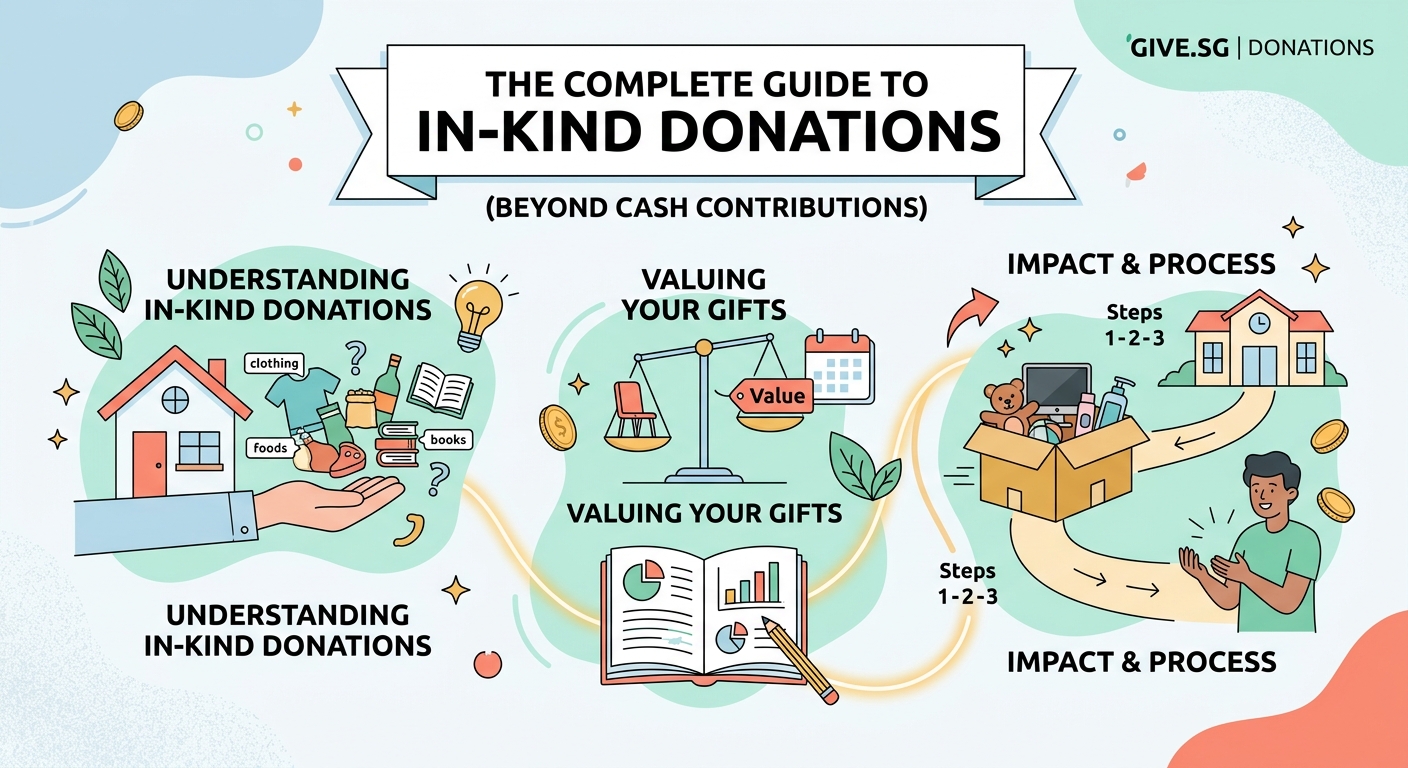
Valuing donations accurately matters for your books and for donor tax deductions. Fair market value (FMV) represents what a willing buyer would pay a willing seller in an open market.
For new items, use the retail price. A brand-new laptop donated by a tech company gets valued at its current selling price, not what the company paid wholesale.
For used goods, consider age, condition, and comparable sales. Thrift store prices, online marketplaces, and appraisal guides provide benchmarks. A three-year-old office desk in good condition might be worth $150, even if it cost $600 new.
For services, use the professional’s standard hourly rate. If a consultant normally charges $175 per hour and donates eight hours, the value is $1,400.
Here’s a breakdown of common valuation approaches:
| Donation Type | Valuation Method | Documentation Needed |
|---|---|---|
| New merchandise | Current retail price | Receipt or catalog listing |
| Used equipment | Comparable sales or appraisal | Photos, condition notes, market research |
| Professional services | Standard billing rate | Time logs, rate sheet |
| Real estate or vehicles | Qualified appraisal | IRS Form 8283 for gifts over $5,000 |
| Event space rental | Market rate for similar venues | Venue contract or rate card |
The IRS requires qualified appraisals for single items or groups of similar items valued over $5,000. Don’t skip this step. Inaccurate valuations create problems during audits.
Recording and reporting these gifts properly
In-kind donations must appear on your financial statements when they meet two criteria: you can reliably measure their value, and they create or enhance non-financial assets, or they require specialized skills you would otherwise purchase.
How to record the transaction
Use a double-entry system. Record the donation as both a debit (asset or expense) and a credit (revenue).
If you receive $2,000 worth of office supplies you’ll use immediately, debit office expense for $2,000 and credit in-kind contribution revenue for $2,000.
If you receive equipment you’ll use for years, debit fixed assets for the FMV and credit in-kind contribution revenue. Then depreciate the asset over its useful life.
What appears on your Form 990
The IRS Form 990 requires nonprofits to report in-kind contributions. You’ll list them in Part VIII (Statement of Revenue) and provide details in Schedule M if your organization received $25,000 or more in non-cash contributions during the year.
Schedule M breaks down contributions by category: art, clothing, food inventory, securities, and more. Accurate categorization helps the IRS understand your revenue sources.
Documentation you must keep
Create a paper trail for every donation. Your records should include:
- Donor name and contact information
- Date of donation
- Detailed description of items or services
- Fair market value and how you determined it
- Any restrictions on use
- Written acknowledgment sent to donor
For donations worth $250 or more, provide a written acknowledgment that includes your organization’s name, donation description, and a statement about whether you provided goods or services in return.
Building a gift acceptance policy that protects your nonprofit
Not every donation deserves a yes. A formal gift acceptance policy helps your team make consistent decisions about what to accept and what to decline.
Your policy should answer these questions:
- What types of donations do we accept without board approval?
- What requires leadership review (real estate, vehicles, restricted gifts)?
- Who evaluates whether a donation aligns with our mission?
- How do we handle donations with strings attached?
- What items do we never accept (hazardous materials, items needing expensive storage)?
“A strong gift acceptance policy isn’t about saying no to generosity. It’s about saying yes to the right gifts at the right time. We learned this after accepting 300 outdated computers that cost us more to recycle than they were worth. Now we evaluate every donation against our current needs and capacity.” — Development Director, education nonprofit
Your policy protects you from well-meaning gifts that create burdens. It also gives staff clear authority to decline inappropriate donations without offending supporters.
Strategies for soliciting in-kind donations effectively
Waiting for donations to appear rarely works. Successful nonprofits actively seek what they need.
1. Create a specific wish list
Generic requests get generic results. Instead of asking for “office supplies,” list exactly what you need: 10 reams of copy paper, five boxes of black pens, three staplers. Post this list on your website, share it in newsletters, and bring it to community meetings.
Update the list regularly. Remove items you’ve received. Add new needs as programs grow.
2. Target businesses that align with your work
Match your ask to the donor’s expertise. Approach restaurants for food donations, law firms for legal services, and furniture stores for office equipment. They’re more likely to say yes when you request what they already provide.
Research corporate giving programs. Many large companies have formal in-kind donation processes. Tech companies often donate software and hardware. Retailers contribute unsold inventory.
3. Make giving easy
Complicated processes kill generosity. Provide clear instructions about when and where donors can drop off items. Offer to pick up large donations. Send a simple form for service providers to log their hours.
The less friction you create, the more people follow through.
4. Show impact through stories
Donors want to know their contributions matter. Share photos of clients using donated computers. Write about how pro bono legal help saved your organization $8,000. Quantify the difference their gifts made.
Recognition motivates repeat giving. Thank donors publicly (with permission) through social media, annual reports, and your website.
Common challenges and how to avoid them
In-kind donations create unique headaches. Here’s how to prevent the most common problems.
Storage limitations: Before accepting physical goods, confirm you have space. Donated furniture sounds great until you realize it won’t fit through your door or requires climate control you don’t have.
Usability mismatches: Just because something is free doesn’t mean it’s useful. Outdated technology, stained clothing, or expired food waste everyone’s time. Politely decline items that don’t serve your current programs.
Valuation disputes: Donors sometimes overestimate what their contributions are worth. A used couch isn’t worth $2,000 just because it cost that much new in 2010. Use objective market data, not sentimental value.
Restricted gifts with impossible conditions: Some donors attach requirements you can’t meet. If someone donates $5,000 worth of equipment but requires you to hire their nephew, that’s a problem. Your gift acceptance policy should address restrictions upfront.
Administrative burden: Processing in-kind donations takes time. Someone must receive items, verify condition, determine value, create records, send acknowledgments, and update your database. Budget staff hours accordingly.
Practical steps to get started today
Ready to incorporate in-kind donations into your fundraising mix? Follow these steps.
-
Audit your current expenses. Review the last six months of spending. Which costs could be covered through donations? Office rent, printing services, event catering, and technology are common candidates.
-
Draft a gift acceptance policy. Use templates from nonprofit associations or legal resources. Customize the policy to reflect your organization’s size, mission, and capacity. Get board approval.
-
Build your wish list. Create a one-page document listing specific items and services you need. Include quantities, preferred brands or specifications, and deadlines if relevant.
-
Identify potential donors. Make a list of 20 businesses or professionals in your community who could provide what you need. Prioritize those with existing connections to your organization.
-
Develop your pitch. Write a short email template explaining your mission, what you need, and how the donation will be used. Personalize each message.
-
Set up tracking systems. Create a spreadsheet or use your donor database to log in-kind contributions. Track donor names, donation dates, item descriptions, values, and acknowledgment status.
-
Train your team. Make sure everyone who interacts with donors understands your acceptance policy, valuation methods, and acknowledgment requirements. Consistency prevents mistakes.
Making in-kind donations work for your mission
In-kind donations expand what your nonprofit can accomplish without expanding your cash budget. But they only create value when you approach them strategically.
Accept donations that genuinely serve your programs. Develop systems to value, record, and acknowledge them properly. Build relationships with donors who can provide ongoing support. And always remember that your mission comes first. A donation that distracts from your work isn’t really a gift.
Start small. Identify one expense you could offset through an in-kind donation this month. Reach out to three potential donors. Test your processes. Learn what works. Then scale up as you gain confidence and capacity.
Your community has resources beyond money. When you create clear pathways for people to share what they have, you build a stronger organization and deeper connections with supporters who want to help in ways that feel natural to them.