 By chloe
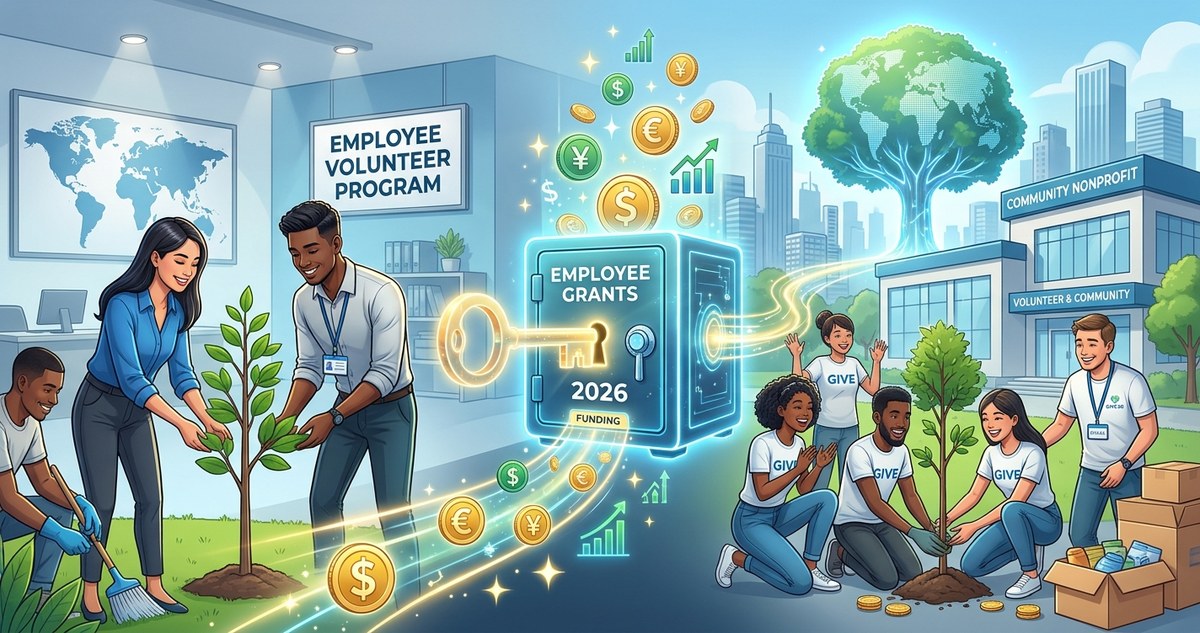
You already know the feeling. A volunteer spends a Saturday morning sorting donations at your warehouse. They leave energized, connected to your mission, and ready to tell their friends. It is a win. But what if that same Saturday morning could also put a check in your nonprofit’s bank account? That is exactly what employee volunteer grant programs are designed to do.
These programs, sometimes called “Dollars for Doers,” are offered by hundreds of companies across the United States. When an employee volunteers a certain number of hours with a qualified nonprofit, the company makes a cash grant to that organization. The volunteer does not have to ask for donations or run a fundraiser. They just have to show up and serve. The money follows. For a small to midsize nonprofit, this can feel like finding hidden treasure in plain sight. In 2026, more companies than ever are expanding these programs, and your organization can benefit.
Employee volunteer grant programs turn donated time into cash for your nonprofit. By helping your volunteers submit their hours through company portals, you can unlock hundreds or even thousands of dollars in unrestricted funding. The key is knowing which companies offer these grants, tracking hours correctly, and making the submission process easy for your supporters.
What Are Employee Volunteer Grant Programs?
Employee volunteer grant programs are corporate philanthropy initiatives that reward volunteerism with direct financial support. Think of them as a cousin to matching gift programs. With a matching gift, a company matches an employee’s cash donation. With a volunteer grant, the company matches the employee’s time.
Here is how it works in practice. A volunteer works at your food bank for ten hours. Their employer, let us say a large tech firm or a regional bank, has a policy that says: “For every 10 hours an employee volunteers, we will donate $250 to the nonprofit.” The volunteer logs their hours through their company’s portal. The company verifies the hours, often by checking with you. Then the company sends your nonprofit a check.
The beauty of this system is that the volunteer does not need to be wealthy. They do not need to write a personal check. They just need to be employed by a company that participates. Your job is to help them connect the dots.
Why These Programs Matter for Your Nonprofit in 2026
The philanthropic landscape is shifting. Individual donors are feeling the pinch of inflation and economic uncertainty. Corporate giving, however, remains strong. Many companies are doubling down on community engagement as a way to retain employees and build their brand. Employee volunteer grant programs are a direct pipeline to those corporate dollars.
For a development director or volunteer coordinator, these grants offer several advantages.
- Unrestricted funding. Most volunteer grants come with no strings attached. You can use the money for operating costs, program supplies, or that broken HVAC unit in the back office.
- Volunteer retention. When a volunteer sees their time translate into real dollars for your cause, they feel more valued and are more likely to return.
- Easy to scale. One volunteer can bring in a grant. Ten volunteers can bring in ten times that amount. There is no cap on your effort.
- Low competition. Many nonprofits are not aware of these programs. By promoting them, you get ahead of the curve.
How to Unlock This Funding: A Step by Step Process
Getting started does not require a massive budget or a dedicated grant writer. It requires a system. Follow these five steps to build a program that works.
1. Identify Which Companies Offer Volunteer Grants
The first step is research. You need to know which employers your volunteers work for. Start by asking your current volunteer base. Send a short email survey or ask during orientation. You can also use a matching gift database tool to search for companies. Many of these databases also include volunteer grant information.
Look for companies of all sizes. Large corporations like Bank of America, Microsoft, and Walmart are well known for these programs. But do not overlook regional banks, local insurance agencies, and mid-sized manufacturing firms. Many of them offer generous programs that fly under the radar.
2. Create a Simple Intake System
Once you know which companies are represented, create a simple way to track volunteer hours. This can be as low tech as a paper sign in sheet or as advanced as a volunteer management app. The key is accuracy. You will need to verify hours when the company asks.
Make sure your system captures the volunteer’s full legal name, the email address they use for work, and the name of their employer. This information is essential for the grant submission process.
3. Educate Your Volunteers
This is the most important step. Many volunteers have no idea their employer offers a volunteer grant program. You need to tell them.
Add a short blurb to your welcome packet. Mention it at the end of a volunteer shift. Send a monthly email that says, “Did you know your company might donate money just because you volunteered with us?” Include a link to a page on your website that lists common companies and their requirements.
4. Help Them Submit
The submission process varies by company. Some use a simple online form. Others require the nonprofit to sign a verification document. Make it easy for your volunteer.
Offer to fill out the company form on their behalf. Send them the information they need, like your organization’s tax ID number. If the company requires a signature from your executive director, make sure that person knows to sign quickly. A delay on your end can mean a missed grant.
5. Follow Up and Say Thank You
When a grant comes in, let the volunteer know. Send them a personal thank you note. Tell them exactly how the money will be used. This reinforces the behavior and makes them more likely to volunteer again. It also encourages them to tell their coworkers.
Common Mistakes and How to Avoid Them
Even well intentioned nonprofits can stumble. Here is a table that outlines common mistakes and the better approach.
| Mistake | Why It Hurts | Better Approach |
|---|---|---|
| Not asking volunteers about their employer | You miss every grant opportunity | Ask during registration and annually in a survey |
| Waiting for volunteers to submit on their own | Most people forget or procrastinate | Offer to submit the hours for them |
| Using a generic volunteer hour log | Companies may reject unverified hours | Use a system that allows you to sign off on each shift |
| Ignoring small companies | You leave money on the table | Research every employer, not just the big names |
| Forgetting to track grant deadlines | Some programs are annual or quarterly | Use a calendar to remind you of submission windows |
Expert advice: “Do not assume your volunteers know about these programs. Even at companies that heavily promote their volunteer grant offerings, many employees are unaware. A simple reminder from your organization can be the nudge they need. Make it a standard part of your volunteer onboarding process.” — Sarah Chen, Nonprofit Consultant
A Practical Example: How One Small Nonprofit Made It Work
Consider the case of a small animal shelter in Ohio. They had about 50 regular volunteers. The development director sent a one question survey: “Who do you work for?” She discovered that 12 volunteers worked for companies with volunteer grant programs. One volunteer worked for a national retailer that offered $500 for every 20 hours volunteered.
She helped that volunteer submit their hours. The grant came through in six weeks. That $500 paid for spay and neuter supplies for an entire month. Then she helped the other 11 volunteers. Over the course of a year, the shelter brought in over $4,000 in volunteer grant funding. The only cost was the time it took to send a few emails and fill out some forms.
Turning Your Volunteers Into Fundraisers
Your volunteers are already your biggest advocates. They give their time because they believe in your mission. With a little guidance, they can also become a reliable source of funding.
You can amplify this effect by creating a culture of awareness around these programs. Here are a few ideas.
- Create a “Corporate Champions” page on your website. List the companies that have funded your organization through volunteer grants. Thank them publicly.
- Host a volunteer grant kickoff event. Invite volunteers from companies that offer these programs. Walk them through the submission process over pizza.
- Integrate the ask into your regular communications. Add a line to your newsletter. Include a mention in your social media posts. Keep it friendly and helpful, not pushy.
Building a Sustainable Pipeline
The real power of employee volunteer grant programs is that they create a self sustaining cycle. A volunteer gives time. The company gives money. The money helps your nonprofit serve more people. Those people become part of your community, and some of them become volunteers themselves.
To keep this cycle running, you need to maintain your systems. Update your volunteer intake forms every year. Reconnect with volunteers who have changed jobs. A volunteer who moved from a company with a program to one without might need to be re educated. Stay on top of company policy changes. Some companies increase their grant amounts in January. Others change their requirements mid year.
The True Cost of Ignoring This Opportunity
If you choose not to pursue employee volunteer grant programs, you are leaving money on the table. It is money that does not require a grant proposal. It does not require a gala. It does not require a major donor meeting. It requires a little bit of organization and a willingness to ask.
In 2026, every dollar counts. Operating costs are rising. Demand for services is increasing. The nonprofits that thrive will be the ones that use every tool available. This is one of the simplest tools you have.
Your Next Steps Start Today
You do not need to overhaul your entire volunteer program to start seeing results. Pick one step from this article and do it this week. Maybe that means adding a question to your volunteer sign up form. Maybe it means sending an email to your current volunteers asking where they work. Maybe it means creating a simple tracking spreadsheet.
The important thing is to start. The volunteers are already there. The companies have already set aside the money. Your job is to bridge the gap. When you do, your nonprofit gets stronger, your volunteers feel more appreciated, and your mission moves forward.
For more ideas on how to make the most of your donations and volunteer efforts, check out our guide on how corporate matching gift programs can double your charitable impact. And if you are looking for ways to build a loyal community of supporters, read about how to build a thriving volunteer community from scratch.
Make Every Hour Count Twice
Your volunteers give you their time. That is a gift. With employee volunteer grant programs, that same hour can also bring in funding. It is a way to honor their effort and strengthen your organization at the same time.
Start small. Be consistent. Celebrate every grant that comes in. Before you know it, you will have built a reliable funding stream that grows alongside your volunteer base. And that is a win for everyone.