 By chloe
Fraudulent crowdfunding campaigns cost platforms millions each year and erode donor trust. A single fake medical fundraiser or fabricated startup pitch can damage a platform’s reputation for years. Traditional manual review processes can’t keep pace with the volume of campaigns launched daily, which is why machine learning has become essential for fraud detection.
Machine learning fraud detection crowdfunding systems analyze patterns across millions of campaigns to flag suspicious behavior before funds change hands. These algorithms examine text content, user behavior, payment patterns, and social signals to protect donors while allowing legitimate campaigns to launch immediately. Modern platforms combine automated detection with human review teams to balance security and user experience.
Why traditional fraud detection fails at scale
Manual review worked when crowdfunding platforms handled dozens of campaigns per day. A small team could read each story, verify photos, and check creator backgrounds before approving campaigns.
That approach breaks down at scale.
Major platforms now process thousands of new campaigns daily. Manual review creates bottlenecks that delay legitimate fundraisers while sophisticated fraudsters learn to game the system. Fraudsters study approval patterns, craft convincing narratives, and exploit the time pressure reviewers face.
Human reviewers also struggle with consistency. One reviewer might flag a campaign as suspicious while another approves an identical setup. Fatigue sets in during long shifts, and subtle red flags get missed.
Machine learning solves these problems by processing every campaign through the same analytical framework, maintaining consistent standards regardless of volume, and learning from new fraud patterns automatically.
How machine learning identifies fraudulent campaigns

Machine learning models analyze hundreds of data points for each campaign, looking for patterns that human reviewers would miss or take hours to uncover.
Text analysis and natural language processing
Fraudulent campaigns often share linguistic patterns. Models trained on thousands of verified fraud cases can spot these tells in seconds.
The algorithm examines word choice, sentence structure, emotional manipulation tactics, and inconsistencies between campaign titles and descriptions. A medical fundraiser that uses identical phrasing to dozens of other campaigns raises flags. Stories that escalate urgency artificially or contain contradictory details get marked for review.
Natural language processing also detects campaigns copied from legitimate fundraisers with minor changes. Fraudsters frequently steal successful campaign text and swap out names or locations.
Behavioral signals from campaign creators
How someone creates and manages a campaign reveals intent. Machine learning tracks these behavioral patterns:
- Account age and activity history before launching a campaign
- Speed of campaign creation from signup to publish
- Photo upload patterns and image manipulation indicators
- Response time to donor questions and comments
- Withdrawal attempt timing and frequency
- Device fingerprints and IP address patterns
A brand new account that creates a campaign in three minutes, uploads stock photos, and requests fund withdrawal before gaining any traction fits a clear fraud pattern.
Network analysis and connection mapping
Sophisticated fraud often involves networks of fake accounts supporting each other. Machine learning models map relationships between accounts, identifying clusters of suspicious activity.
The system tracks shared payment methods, overlapping IP addresses, coordinated donation patterns, and cross-campaign commenting behavior. When ten “different” donors all use similar naming patterns and donate to the same set of campaigns, the algorithm recognizes the coordination.
Payment and financial behavior patterns
Transaction data provides powerful fraud signals. Machine learning models analyze donation amounts, timing, and sources to spot anomalies.
Legitimate campaigns typically show organic growth with varied donation amounts. Fraudulent campaigns often display artificial patterns like identical donation amounts from multiple sources, donations clustered in suspicious timeframes, or payment methods associated with previous fraud.
Building an effective fraud detection system
Implementing machine learning for fraud detection requires careful planning and ongoing refinement. Here’s how platforms build systems that work:
-
Collect comprehensive training data from historical campaigns, including confirmed fraud cases, legitimate campaigns, and edge cases that required manual review. The model needs examples of subtle fraud that almost passed review.
-
Engineer features that capture fraud signals across multiple dimensions, combining text analysis, user behavior, network patterns, and financial data into a unified scoring system. Each feature should add unique predictive value.
-
Train ensemble models that combine multiple algorithms, using random forests for pattern recognition, neural networks for complex text analysis, and gradient boosting for behavioral scoring. Different algorithms catch different fraud types.
-
Implement real-time scoring that evaluates campaigns at creation and monitors them throughout their lifecycle, adjusting risk scores as new information emerges. A campaign that seemed legitimate at launch might show fraud signals after receiving donations.
-
Create feedback loops where human reviewers label edge cases, feeding this data back into the model to improve accuracy. The system learns from every decision.
-
Balance false positives against false negatives, tuning thresholds based on platform risk tolerance. Blocking too many legitimate campaigns hurts user experience while missing fraud damages trust.
Common machine learning techniques for fraud detection
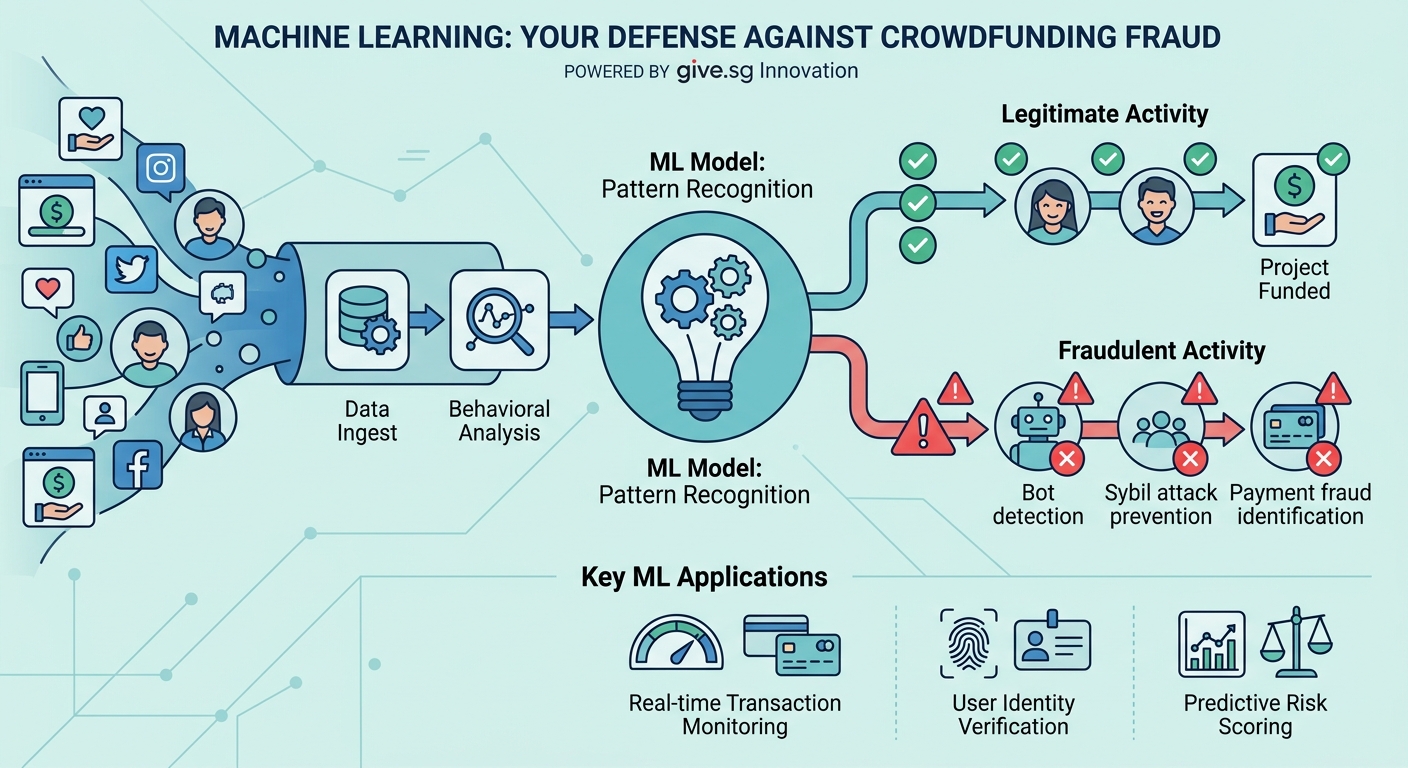
Different algorithms excel at different aspects of fraud detection. Most platforms use multiple techniques in combination.
| Technique | Best For | Limitations |
|---|---|---|
| Random forests | Identifying clear fraud patterns across structured data | Struggles with novel fraud tactics |
| Neural networks | Analyzing unstructured text and images for subtle manipulation | Requires large training datasets |
| Anomaly detection | Flagging unusual behavior that doesn’t match known patterns | Generates many false positives |
| Graph analysis | Mapping fraud networks and coordinated campaigns | Computationally expensive at scale |
| Gradient boosting | Combining weak signals into strong fraud predictions | Can overfit on training data |
The most effective systems layer these techniques, using fast algorithms for initial screening and more sophisticated models for borderline cases.
Real-world applications and results
Platforms implementing machine learning fraud detection report significant improvements in both fraud prevention and operational efficiency.
One major crowdfunding platform reduced fraudulent campaigns by 73% in the first year after deploying machine learning systems. The automated screening freed human reviewers to focus on complex cases requiring judgment calls rather than processing obvious fraud.
Another platform cut false positive rates by 45% by training models on feedback from overturned decisions. When legitimate campaigns got incorrectly flagged, that data improved the model’s ability to distinguish edge cases from actual fraud.
The key is not replacing human judgment but augmenting it. Machine learning handles pattern recognition at scale while experienced reviewers tackle nuanced situations where context matters more than data points.
Medical fundraising platforms face particular challenges with emotional manipulation. Fraudsters create fake illness campaigns that generate sympathy donations before verification can occur. Machine learning models trained on verified medical fraud now flag suspicious medical claims, inconsistent medical terminology, and stolen patient photos within minutes of campaign creation.
Challenges and limitations
Machine learning fraud detection isn’t perfect. Several challenges require ongoing attention:
Adversarial adaptation means fraudsters constantly evolve tactics to bypass detection systems. As models learn to catch one fraud pattern, bad actors develop new approaches. This creates an arms race requiring continuous model updates.
Data imbalance poses technical problems since legitimate campaigns vastly outnumber fraudulent ones. Models can become biased toward approving campaigns, missing subtle fraud to avoid false positives. Techniques like synthetic minority oversampling help but don’t fully solve the problem.
Explainability matters when platforms need to tell users why their campaign was flagged. Black box neural networks that can’t articulate their reasoning create frustration and support burdens. Many platforms prioritize interpretable models even if they sacrifice some accuracy.
Cultural and linguistic diversity challenges models trained primarily on English-language campaigns. Fraud patterns vary across regions, and translation introduces noise. Platforms operating globally need region-specific models or multilingual training data.
Privacy concerns arise when systems collect extensive behavioral data for fraud detection. Balancing security with user privacy requires careful data governance and transparent policies about what information gets collected and how long it’s retained.
Features that improve detection accuracy
Beyond core algorithms, several features significantly boost fraud detection performance:
- Image reverse search integration catches campaigns using stolen photos from news articles or other fundraisers
- Social media verification confirms that campaign creators have established online presences matching their stated identity
- Document authentication uses computer vision to detect forged medical bills, legal documents, or identification
- Velocity checks flag accounts creating multiple campaigns in short periods or making rapid changes to campaign details
- Donor sentiment analysis monitors comments and messages for complaints about suspicious campaign elements
- Geolocation validation ensures IP addresses, phone numbers, and stated locations align logically
These features work best when combined into comprehensive risk scores rather than used as standalone tests. A single red flag might be explainable, but multiple signals pointing toward fraud warrant human review.
Balancing security with user experience
Aggressive fraud detection can harm legitimate fundraisers who need immediate access to funds. Finding the right balance requires thoughtful system design.
Tiered review processes let obviously legitimate campaigns publish instantly while routing questionable cases through additional checks. Most campaigns never see delays, but high-risk patterns trigger holds.
Progressive verification allows campaigns to launch with basic checks but requires additional verification before large withdrawals. A medical campaign can accept donations immediately but needs documentation before accessing funds.
Transparent communication helps users understand why their campaign was flagged and what steps resolve the issue. Generic rejection messages create frustration while specific guidance enables legitimate users to provide needed information.
Appeal mechanisms give wrongly flagged campaigns paths to human review. Machine learning makes mistakes, and accessible appeals prevent those errors from permanently blocking valid fundraisers.
The future of machine learning in crowdfunding security
Emerging technologies promise even more sophisticated fraud detection capabilities.
Deepfake detection will become critical as synthetic media makes fake campaign photos and videos harder to spot. Computer vision models that detect subtle artifacts from AI-generated content are already being integrated into fraud systems.
Behavioral biometrics analyze typing patterns, mouse movements, and mobile device interactions to verify that the person creating a campaign matches the claimed identity. These passive checks happen without user friction.
Federated learning allows platforms to share fraud intelligence without exposing individual campaign data, building stronger collective defenses while protecting privacy.
Real-time collaboration networks connect platforms to share fraud signals as they emerge, preventing fraudsters from moving between services after getting caught.
Predictive modeling will shift from reactive fraud detection to proactive risk assessment, identifying accounts likely to commit fraud before they launch campaigns based on subtle behavioral indicators.
Building trust through transparency
The most successful platforms treat fraud detection as part of their value proposition rather than a hidden security measure.
They publish fraud statistics showing how many fake campaigns get caught, educate donors about red flags to watch for, and explain how machine learning protects the community. This transparency builds confidence that donations reach intended recipients.
Platforms also invest in fraud detection as a competitive advantage. Donors gravitate toward services with strong reputations for security, and campaign creators prefer platforms that won’t damage their credibility by association with fraud.
Protecting donors while empowering creators
Machine learning fraud detection represents a fundamental shift in how crowdfunding platforms maintain trust. Automated systems process vast amounts of data to identify threats that would overwhelm human review teams, catching sophisticated fraud while letting legitimate campaigns launch without delay.
The technology continues improving as models learn from new fraud patterns and platforms share intelligence. For operators and fraud prevention specialists, staying current with machine learning techniques isn’t optional anymore. It’s the foundation of platform security and user trust at scale.
The platforms that win will be those that deploy machine learning thoughtfully, balancing aggressive fraud detection with user experience, transparency with security, and automation with human judgment. Your donors deserve that protection, and your legitimate campaign creators deserve platforms that don’t punish them for the actions of fraudsters.