 By chloe
You want to make a difference. But you also want to be smart about it.
The good news? Strategic charitable giving lets you do both. When you understand how tax deductions work alongside your philanthropic goals, every dollar goes further. You support the causes that matter to you while reducing your tax burden in ways that make financial sense.
Strategic charitable giving tax strategies help you maximize deductions while amplifying your philanthropic impact. By donating appreciated assets, bunching contributions, using donor-advised funds, and timing gifts strategically, you can reduce taxable income significantly. The most effective approach combines multiple techniques based on your financial situation, creating lasting change for causes you care about while optimizing your tax position.
Understanding How Tax Deductions Work for Charitable Gifts
Before jumping into specific strategies, you need to know the basics.
The IRS allows you to deduct charitable contributions if you itemize deductions on your tax return. For 2025, you can deduct cash donations up to 60% of your adjusted gross income. Non-cash assets like stocks or real estate have different limits, typically 30% of AGI.
But here’s the catch: you only benefit if your total itemized deductions exceed the standard deduction. For 2025, that’s $14,600 for single filers and $29,200 for married couples filing jointly.
Many taxpayers take the standard deduction and miss out on charitable tax benefits entirely. That’s where smart planning comes in.
The strategies below help you structure your giving to maximize both impact and tax savings.
Donate Appreciated Assets Instead of Cash
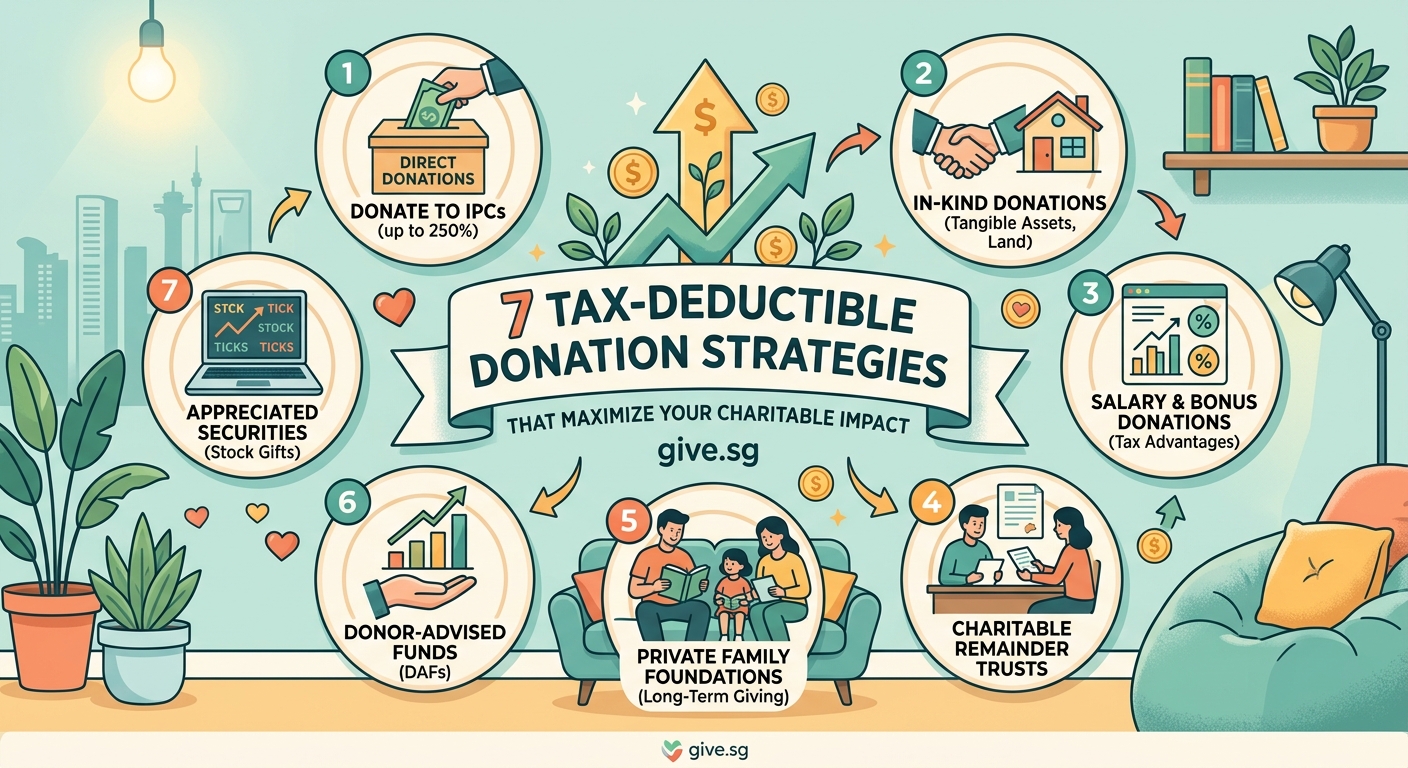
This might be the most powerful strategy available.
When you donate stock, real estate, or other appreciated assets you’ve held for more than a year, you get two tax benefits. First, you deduct the full fair market value. Second, you avoid paying capital gains tax on the appreciation.
Let’s say you bought stock for $5,000 that’s now worth $15,000. If you sell it and donate the cash, you’ll owe capital gains tax on the $10,000 gain. At a 15% rate, that’s $1,500 in taxes. You’d have $13,500 left to donate.
Instead, donate the stock directly. The charity gets the full $15,000. You deduct $15,000. And you never pay the capital gains tax.
This works for:
- Publicly traded stocks and bonds
- Mutual funds and ETFs
- Real estate
- Privately held business interests
- Cryptocurrency (with special rules)
Most charities can accept these gifts. Some have specific processes, so check with them first.
Bundle Your Donations Through Bunching
Bunching concentrates multiple years of donations into a single tax year.
Here’s why it works. If you normally give $10,000 annually, that might not exceed the standard deduction when combined with your other deductions. But if you give $30,000 in one year (three years’ worth), you’ll likely itemize that year and take the standard deduction the next two years.
The math often works in your favor.
Follow these steps:
- Calculate your typical annual charitable giving amount
- Determine how many years’ worth you can afford to give upfront
- Make the bundled donation in a high-income year for maximum benefit
- Take the standard deduction in the following years
- Resume the pattern when it makes sense again
You can combine bunching with a donor-advised fund to maintain your annual support to charities while concentrating the tax deduction.
Use a Donor-Advised Fund for Flexibility
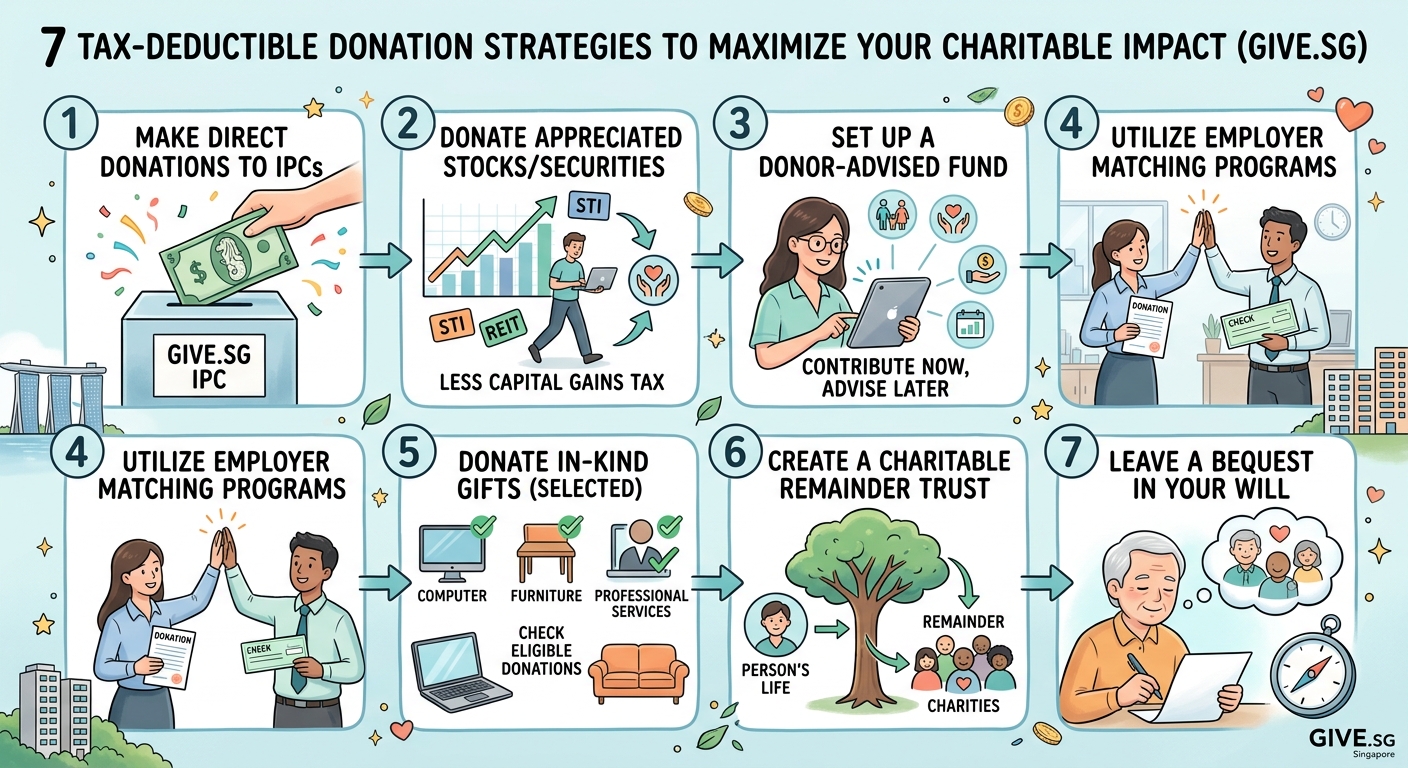
A donor-advised fund (DAF) acts like a charitable investment account.
You contribute to the fund and get an immediate tax deduction. The money grows tax-free. Then you recommend grants to charities over time, whenever you want.
This solves several problems at once. You can bunch contributions for tax purposes while spreading actual grants to charities across multiple years. You can donate complex assets like private stock or real estate more easily. And you create a simple giving vehicle that your whole family can participate in.
The process looks like this:
- Open a DAF account with a sponsoring organization
- Contribute cash, securities, or other assets
- Claim your tax deduction for the year of contribution
- Recommend grants to qualified charities whenever you choose
- Watch the remaining balance grow tax-free for future giving
DAFs have become incredibly popular. They’re easier to set up than private foundations and have much lower administrative costs.
Make Qualified Charitable Distributions from Your IRA
If you’re 70½ or older, this strategy is a game changer.
A qualified charitable distribution (QCD) lets you transfer up to $105,000 annually (for 2025) directly from your IRA to charity. The distribution doesn’t count as taxable income. And if you’re 73 or older, it counts toward your required minimum distribution.
This is especially valuable if you don’t itemize deductions. You get a tax benefit even while taking the standard deduction.
The rules are specific:
- You must be at least 70½ years old
- The transfer must go directly from your IRA to the charity
- The charity must be a qualified 501(c)(3) organization
- You cannot receive any goods or services in return
- You won’t get a separate charitable deduction (the tax-free treatment is the benefit)
Work with your IRA custodian to process the transfer correctly. Documentation matters here.
Time Your Gifts Strategically
When you give can be just as important as what you give.
High-income years are prime opportunities for charitable giving. If you sell a business, receive a bonus, or have an unusually profitable year, charitable contributions can offset that income.
Consider these timing strategies:
- Make donations before December 31 to claim deductions for the current tax year
- Bunch gifts into years when you’ll be in a higher tax bracket
- Coordinate with Roth conversion years to offset the additional taxable income
- Plan around retirement to maximize deductions while you’re still in peak earning years
- Use appreciated assets in years when capital gains rates might increase
Tax law changes can also create timing opportunities. Stay informed about proposed legislation that might affect charitable deductions.
Establish a Charitable Remainder Trust
This advanced strategy works well for high-net-worth individuals with significant appreciated assets.
A charitable remainder trust (CRT) lets you donate assets to an irrevocable trust, receive income for a period of time, and then pass the remainder to charity. You get a partial tax deduction when you fund the trust based on the present value of the charity’s eventual remainder interest.
The trust sells the appreciated assets without paying capital gains tax. Then it invests the proceeds and pays you income for life or a term of years.
Here’s what makes it powerful:
- Immediate partial tax deduction
- Elimination of capital gains tax on highly appreciated assets
- Income stream for you or your beneficiaries
- Ultimate charitable gift
- Potential reduction in estate taxes
CRTs require professional setup and ongoing administration. They make sense when you have substantial appreciated assets and want both income and charitable impact.
Compare Common Strategies Side by Side
Different approaches work for different situations. This table breaks down the key differences:
| Strategy | Best For | Tax Benefit | Complexity | Ongoing Commitment |
|---|---|---|---|---|
| Cash donation | Simple giving | Deduction up to 60% AGI | Low | None |
| Appreciated assets | Investors with gains | Deduction + avoided capital gains | Medium | None |
| Bunching | Borderline itemizers | Maximized itemized deductions | Low | Multi-year planning |
| Donor-advised fund | Flexible givers | Immediate deduction, future grants | Medium | Optional ongoing grants |
| QCD from IRA | Retirees 70½+ | Tax-free distribution | Low | Annual decision |
| Charitable remainder trust | High-net-worth donors | Partial deduction + income stream | High | Long-term structure |
Match your strategy to your financial situation and charitable goals.
Avoid These Common Mistakes
Even experienced donors make errors that reduce their tax benefits.
Don’t donate assets you’ve held for less than a year. Short-term capital gains assets only give you a deduction for your cost basis, not the current value. You lose the appreciation benefit.
Don’t forget documentation. You need written acknowledgment from the charity for any donation over $250. For non-cash gifts over $500, you’ll need to file Form 8283. Appraisals are required for property valued over $5,000.
Don’t donate to non-qualified organizations. Not all nonprofits qualify for tax-deductible contributions. Political organizations, social clubs, and some foreign charities don’t count. Verify the organization’s 501(c)(3) status.
Don’t ignore state tax benefits. Some states offer additional tax credits or deductions for certain charitable contributions. Check your state’s rules.
Don’t wait until December 31 to plan. Last-minute giving often means missed opportunities for more strategic approaches.
Combine Strategies for Maximum Impact
The most sophisticated donors layer multiple techniques.
You might donate appreciated stock to a donor-advised fund (combining asset donation with bunching flexibility). Or make a QCD from your IRA while also establishing a charitable remainder trust for other assets.
“The best charitable giving strategy isn’t about finding one perfect technique. It’s about creating a comprehensive plan that aligns your values, your financial situation, and your tax position. When these elements work together, you create sustainable impact while optimizing your tax benefits.”
Think about your giving as a multi-year plan, not a single-year event.
Working With Professionals
Complex strategies require expert guidance.
Your financial advisor can help you identify which assets to donate and when. Your tax preparer ensures you claim deductions correctly and file the right forms. An estate planning attorney can structure trusts and other advanced vehicles.
These professionals should work together. Your giving strategy touches multiple areas of your financial life.
Don’t let professional fees deter you from larger gifts. The tax savings and increased impact usually far exceed the cost of good advice.
Making Your Charitable Dollars Go Further
Tax benefits aren’t the only way to amplify your impact.
Some employers match charitable contributions. That doubles your gift at no additional cost to you. Check your company’s matching gift program and follow their process.
Consider supporting charities during matching campaigns or challenge grants. Your donation might be matched by other donors or foundations.
Research charity effectiveness. Organizations that demonstrate measurable impact make your contributions work harder. Look at overhead ratios, program outcomes, and long-term sustainability.
Think about unrestricted vs. restricted gifts. Unrestricted donations give charities flexibility to use funds where they’re needed most. Restricted gifts ensure your money goes to specific programs you care about.
Planning Around Life Changes
Major life events create charitable planning opportunities.
Selling a business generates significant capital gains. Charitable giving can offset some of that tax burden while creating a lasting legacy.
Retirement changes your tax picture dramatically. Your income might drop, but required minimum distributions from retirement accounts can push you into higher brackets. QCDs help manage that.
Inheritance of appreciated assets gives you a stepped-up basis. But if you inherit an IRA, charitable strategies can help manage the tax impact of required distributions.
Moving to a state with different tax laws might change the math on charitable deductions. Some states offer better benefits than others.
Building a Sustainable Giving Plan
One-time gifts are great. But recurring giving creates predictable support for organizations.
Set up automatic monthly donations to your favorite charities. This spreads your impact throughout the year and helps organizations with cash flow planning.
Create a giving budget as part of your overall financial plan. Decide what percentage of your income or assets you want to dedicate to charity. Review and adjust annually.
Involve your family in giving decisions. This teaches values and creates shared purpose. Donor-advised funds work well for family giving because multiple generations can participate.
Document your charitable intentions. If certain causes matter deeply to you, make sure your estate plan reflects that. Charitable bequests can create lasting impact beyond your lifetime.
Turning Strategy Into Action
You now have the framework. The next step is implementation.
Start by reviewing your current giving patterns. How much do you typically donate? To which organizations? In what form (cash, assets, time)?
Then look at your tax situation. Do you itemize or take the standard deduction? What’s your marginal tax rate? Do you have appreciated assets? Are you approaching retirement age?
Match strategies to your situation. If you’re close to the itemization threshold, bunching might work well. If you have significant stock gains, asset donation makes sense. If you’re over 70½, explore QCDs.
Take action before year-end if you want current-year tax benefits. But don’t rush major decisions. Some strategies require time to implement properly.
Your Impact Starts Now
Charitable giving tax strategies aren’t about gaming the system. They’re about being intentional with your generosity.
When you give strategically, you support causes you care about while keeping more resources available for future giving. You create sustainable impact rather than one-time gestures. And you model thoughtful philanthropy for others.
The tax code rewards charitable giving because society benefits when private citizens support important causes. Take advantage of these incentives. Use them to amplify your impact. And know that your strategic approach means more resources flowing to the organizations making a real difference in the world.
Start with one strategy that fits your current situation. Build from there. Your charitable legacy is waiting.